
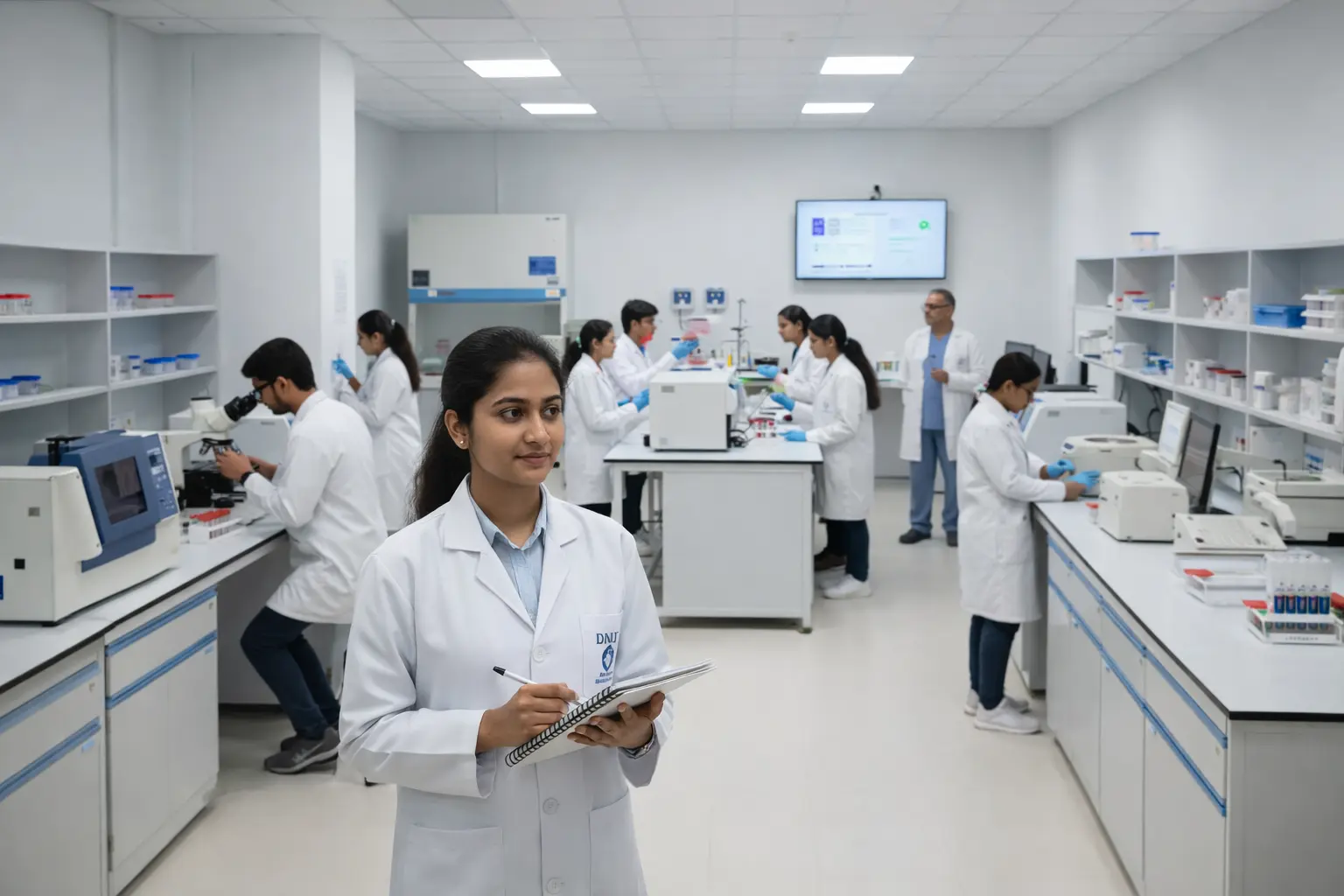


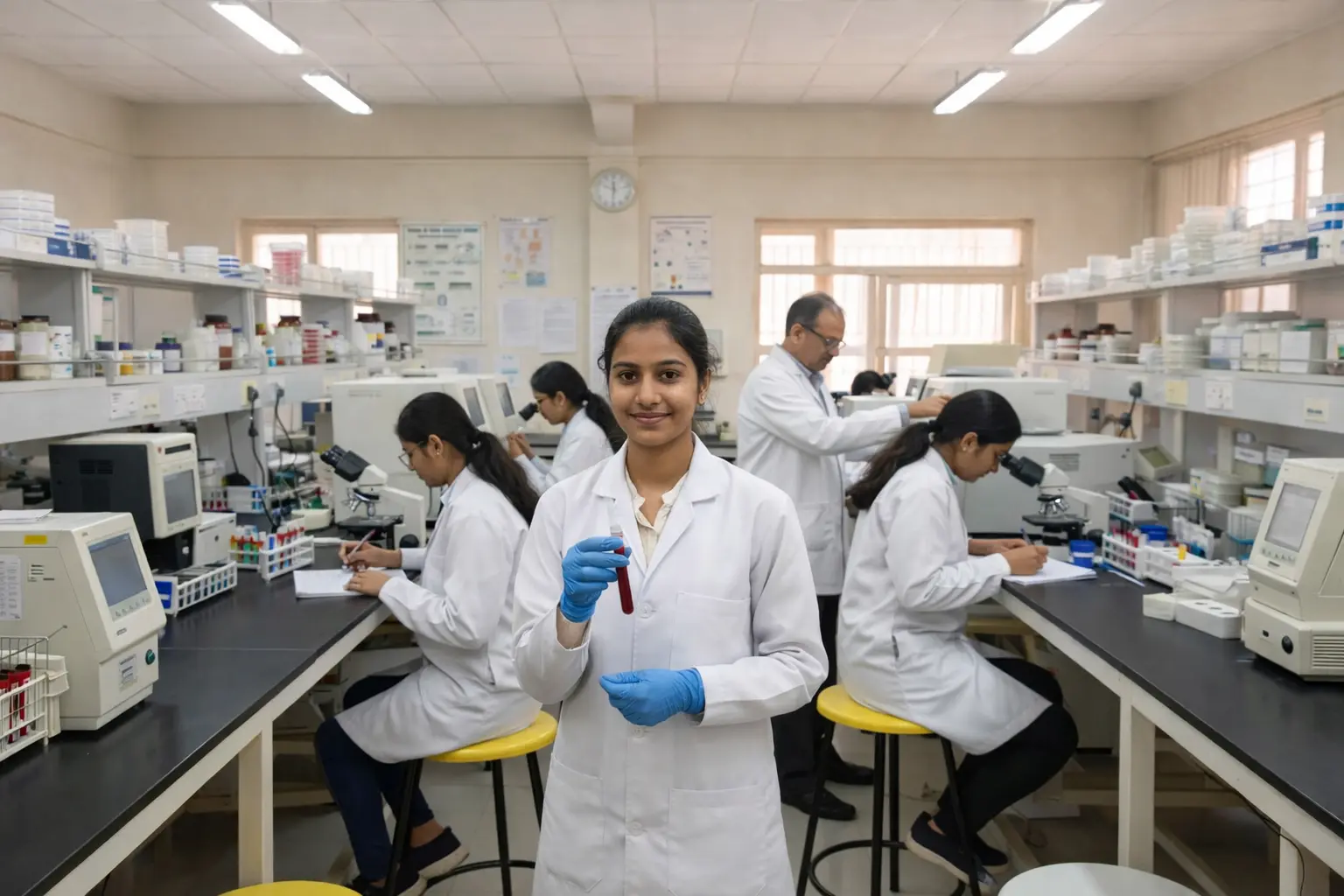
Yes, MSc MLT is a promising career option for graduates who want to specialise in medical laboratory science. The degree opens opportunities in hospitals, diagnostic laboratories, research organisations, biotechnology companies, and healthcare institutions, with better career growth than an undergraduate qualification.
Admissions Open for September 2026 Intake - Limited Seats
Paramedical
MSc Medical Lab Technology: Salary, Scope & Course Details
Jul 24th , 2026
Already have a BSc MLT and wondering what's next? MSc Medical Lab Technology is a popular choice for graduates looking to advance their expertise. An MSc in Medical Laboratory Technology, or MSc MLT, is a two-year postgraduate program that transforms a laboratory technologist into a specialist prepared for advanced diagnostics, research, and supervisory roles.
With hospitals, diagnostic centres, and research laboratories increasingly hiring postgraduate-qualified professionals, it has become one of the most sought-after paramedical courses among BSc MLT graduates today.
This guide covers what the course involves, its duration, MSc MLT scope, salary, job roles, eligibility, fees, and syllabus, giving you everything you need to make an informed decision.
Still exploring the field from the beginning? Our guide on Medical Laboratory Technology Courses is the perfect place to start before considering the postgraduate route.
What is MSc Medical Lab Technology?
MSc Medical Lab Technology is a two-year postgraduate program that prepares graduates for advanced roles in laboratory diagnostics, clinical research, quality assurance, and laboratory management.
Designed primarily for BSc MLT graduates, the course develops specialised expertise in disease diagnosis, modern laboratory techniques, and evidence-based healthcare, enabling professionals to contribute to accurate patient care and medical advancements.
Unlike an undergraduate program that focuses on fundamental laboratory procedures, the MSc in Medical Laboratory Technology emphasises advanced diagnostic methods, research, laboratory automation, and quality control.
Students may specialise in areas such as Microbiology, Clinical Biochemistry, Haematology, Molecular Biology, or Clinical Pathology, opening up career opportunities in hospitals, diagnostic laboratories, research organisations, public health laboratories, and the healthcare industry.
Start Your Medical Career with Bachelor’s Degree in MLT from Top Universities - 100% Placement Support - Admissions are Open for 2026 Batch


MSc MLT Course Details
Before exploring each section in detail, take a look at the key MSc MLT course details in the table below for a quick understanding of the program.
| Particular | Details |
|---|---|
| Course Name | MSc Medical Lab Technology |
| Full Form | Master of Science in Medical Laboratory Technology |
| Course Level | Postgraduate (PG) |
| MSc MLT Course Duration | 2 years (4 semesters) |
| Eligibility | BSc MLT or a related Life Sciences degree from a recognised university |
| Admission Mode | Merit-based or entrance exam, depending on the university |
| MSc MLT Entrance Exam | CUET PG and university or institution-specific entrance tests (where applicable) |
| Training Method | Classroom learning, laboratory practicals, research work, seminars, and dissertation |
| Career Focus | Advanced diagnostics, clinical research, laboratory management, and quality assurance |
| Career Areas | Hospitals, diagnostic laboratories, research institutes, biotechnology companies, pharmaceutical industries, and public health laboratories |
MSc MLT Course Duration
The MSc MLT course duration is 2 years, divided into 4 semesters. Most universities offer the program in full-time mode.
Key Highlights:
- Full-time MSc Medical Lab Technology programs are generally completed in 2 years.
- Part-time programs, where available, may take up to 3 years, depending on the university's academic structure.
- Some universities also offer distance learning options for working professionals.
MSc MLT Scope: Where This Degree Takes You
The MSc MLT scope continues to grow as healthcare increasingly depends on accurate laboratory diagnostics, advanced testing, and medical research. With the expansion of hospitals, diagnostic centres, biotechnology companies, and research organisations, postgraduate-qualified laboratory professionals are finding opportunities across a wide range of healthcare sectors.
After completing MSc Medical Lab Technology, graduates can explore opportunities in:
- Clinical and Diagnostic Laboratories: Work in hospitals, pathology laboratories, and diagnostic centres as laboratory scientists, supervisors, or quality professionals.
- Research Organisations: Join research institutes, biotechnology companies, and pharmaceutical organisations as research associates, clinical research professionals, or laboratory scientists.
- Public Health and Government Laboratories: Explore opportunities in government hospitals, public health laboratories, blood banks, forensic laboratories, and disease surveillance programs through eligible recruitment processes.
- Pharmaceutical and Biotechnology Industry: Contribute to quality control, quality assurance, product development, laboratory validation, and clinical research activities.
- Teaching and Higher Education: Pursue careers in teaching, laboratory instruction, or academic research after meeting the eligibility requirements of the respective institution.
Compared with an undergraduate qualification, a career after MSc MLT offers access to more specialised roles, greater responsibilities, and wider opportunities in diagnostics, research, healthcare, and laboratory management.
To see how this compares with opportunities right after a bachelor's degree, check out our guide on BSc Medical Lab Technology: Scope, Salary & Job Opportunities.
Start Your Medical Career with Bachelor’s Degree in MLT from Top Universities - 100% Placement Support - Admissions are Open for 2026 Batch
MSc Medical Laboratory Technology Salary
The MSc Medical Laboratory Technology salary depends on factors such as experience, job role, specialisation, employer, and location. Graduates working in hospitals, diagnostic laboratories, research organisations, biotechnology companies, and healthcare institutions can expect steady salary growth as they gain experience and advanced technical skills.
The table below provides an estimated range of the MSc MLT salary in India per month and annual salary based on experience.
| Experience | MSc MLT Salary in India Per Month | Average Annual Salary |
|---|---|---|
| 0-1 Year | ₹25,000 - ₹42,000 | ₹3.5 LPA - ₹5 LPA |
| 1-3 Years | ₹42,000 - ₹58,000 | ₹5 LPA - ₹7 LPA |
| 3-5 Years | ₹58,000 - ₹75,000 | ₹7 LPA - ₹9 LPA |
| 5+ Years | ₹75,000 - ₹1,00,000+ | ₹9 LPA - ₹12 LPA+ |
Professionals with specialised skills in areas such as molecular diagnostics, clinical research, quality assurance, and laboratory management may earn higher salaries depending on their expertise and organisation.
MSc MLT Jobs: Career Paths After the Degree
MSc MLT jobs are available across hospitals, diagnostic laboratories, research organisations, biotechnology companies, and healthcare institutions. The degree prepares graduates for specialised roles in diagnostics, quality management, research, and laboratory operations.
| Job Role | Career Responsibilities |
|---|---|
| Clinical Laboratory Scientist / Technologist | Perform advanced diagnostic tests, analyse samples, and prepare accurate laboratory reports to support clinical decisions. |
| Laboratory Manager / Supervisor | Manage laboratory operations, maintain quality standards, and supervise technical teams. |
| Research Associate | Assist in clinical research projects, diagnostic studies, and laboratory-based research activities. |
| Quality Control / Quality Assurance Analyst | Monitor laboratory processes, maintain testing accuracy, and ensure compliance with quality standards. |
| Molecular Diagnostics Specialist | Perform advanced diagnostic procedures involving molecular testing and specialised laboratory techniques. |
| Microbiologist / Clinical Biochemist | Work in specialised laboratory departments based on subject expertise and specialisation. |
| Lecturer / Laboratory Instructor | Teach medical laboratory science subjects and provide practical training in allied health institutions based on eligibility requirements. |
The career after MSc MLT depends on specialisation, technical skills, and experience. Graduates can build careers in clinical diagnostics, research, laboratory management, and healthcare services.
To see how these roles compare with a technologist-level job, read our guide on Medical Laboratory Technologist: Role, Salary & Jobs.
Government Jobs for MSc MLT
Government jobs for MSc MLT are available in government hospitals, medical colleges, public health laboratories, research institutes, blood banks, and healthcare organisations. Recruitment may be conducted for laboratory-related positions such as Laboratory Technologist, Technical Officer, Scientific Assistant, and other similar roles based on eligibility criteria.
These positions offer structured career growth, government pay scales, and additional benefits. However, vacancies are limited, and selection is based on the recruitment process conducted by the respective organisation.
Eligibility For MSc MLT
The MSc Medical Lab Technology eligibility criteria are generally similar across most universities in India, although the minimum marks and admission process may vary between institutions. Candidates should always check the specific requirements of their preferred university before applying.
The basic eligibility for MSc MLT includes:
- A Bachelor's degree in Medical Laboratory Technology (BSc MLT) from a recognised university.
- Some universities also accept candidates with related science backgrounds such as Microbiology, Biochemistry, Biotechnology, or Life Sciences.
- A minimum of 50% to 55% marks in the undergraduate program is generally required. Relaxation may be available to reserved-category candidates as per university rules.
- Admission may be based on merit or entrance examination, depending on the institute.
Meeting the eligibility criteria allows graduates to apply to MSc Medical Lab Technology programs and pursue advanced study in laboratory diagnostics, research, and specialised healthcare fields.
MSc MLT Entrance Exam
Admission to MSc Medical Lab Technology is offered through merit-based selection, entrance examinations, or a combination of both, depending on the university. While many institutions consider a candidate's BSc marks for admission, others require candidates to qualify for an entrance examination.
The table below highlights the common MSc MLT entrance exam options accepted by different universities and institutions.
| Entrance Exam / Admission Mode | Accepted By |
|---|---|
| CUET PG | Central universities and participating institutions |
| University Level Entrance Exams | State, private, and deemed universities |
| Institution Specific Entrance Tests | Universities and institutes such as AIIMS, JIPMER, and other institutions (where applicable) |
| Merit-Based Admission | Many private and state universities |
Start Your Medical Career with Bachelor’s Degree in MLT from Top Universities - 100% Placement Support - Admissions are Open for 2026 Batch
MSc MLT Course Fees
The MSc MLT course fees vary depending on the type of institution, location, and facilities offered. Government colleges generally have lower fees, while private and deemed universities charge higher tuition based on infrastructure, laboratory facilities, and clinical training.
| Institute Type | Estimated Total Course Fees (2 Years) |
|---|---|
| Government / Government Aided Colleges | ₹20,000 - ₹1,20,000 |
| Private Universities | ₹1.5 Lakh - ₹5 Lakh |
| Deemed Universities | ₹2 Lakh - ₹6 Lakh |
| Premier Institutes (AIIMS, JIPMER and similar institutes) | Significantly lower than most universities (as per institute fee structure) |
In addition to the tuition fee, students may need to pay separately for hostel accommodation, examination fees, laboratory materials, uniforms, caution deposits, and other university charges.
Candidates should always verify the latest MSc MLT course fees on the official website of their preferred institution before applying.
MSc MLT Syllabus
The MSc MLT syllabus is designed to provide advanced knowledge in laboratory diagnostics, research, and healthcare sciences. Although the curriculum varies across universities, most MSc Medical Lab Technology programs follow a similar two-year structure.
Year 1 Syllabus: Building Advanced Laboratory Foundations
| Subject | What You'll Learn |
|---|---|
| Advanced Clinical Biochemistry | Study biochemical investigations and disease diagnosis. |
| Advanced Haematology | Learn blood disorders, blood analysis, and haematological techniques. |
| Clinical Microbiology | Identify bacteria, viruses, fungi, and other infectious organisms. |
| Immunology and Serology | Understand immune responses and serological testing methods. |
| Clinical Pathology | Analyse body fluids and laboratory investigations for disease detection. |
| Laboratory Instrumentation | Learn the operation, calibration, and maintenance of laboratory equipment. |
| Research Methodology | Develop scientific research and study design skills. |
| Biostatistics | Apply statistical methods for healthcare and laboratory research. |
Year 2 Syllabus: Specialisation and Clinical Research
| Subject | What You'll Learn |
|---|---|
| Molecular Biology and Diagnostics | Perform molecular and genetic diagnostic techniques. |
| Histopathology and Cytology | Examine tissues and cells to identify diseases. |
| Laboratory Management and Quality Assurance | Maintain laboratory quality standards and accreditation practices. |
| Biosafety and Laboratory Ethics | Follow laboratory safety protocols and ethical practices. |
| Advanced Diagnostic Techniques | Apply specialised laboratory investigations for complex diseases. |
| Dissertation / Research Project | Conduct independent research under faculty supervision. |
| Seminar and Case Presentation | Present clinical cases and research findings. |
| Clinical Training / Internship | Gain practical experience in hospitals and diagnostic laboratories. |
The MSc MLT syllabus may differ slightly depending on the university, specialisation, and curriculum.
Planning to Pursue MSc MLT? Start With the Right BSc Foundation
An MSc Medical Lab Technology builds on the knowledge and practical skills developed during a bachelor's degree. Choosing the right BSc program is an important first step, as it provides the academic foundation and laboratory experience needed for advanced studies and long-term career growth.
If you're still comparing BSc options, our guide on BSc Medical Lab Technology: Course Details, Duration, Eligibility, Fees & Syllabus covers everything you need before choosing a university.
Emversity's BSc Medical Laboratory Technology program helps students build this strong foundation through:
- Comprehensive curriculum that covers the core concepts of medical laboratory science.
- Extensive practical training to develop hands-on skills in clinical diagnostics, laboratory testing, and sample analysis.
- Exposure to modern laboratory equipment and industry-standard practices used in healthcare sectors.
- Learning in real healthcare environments, helping students understand laboratory workflows and patient-centred diagnostics.
- Industry-relevant skill development that prepares graduates for employment as well as higher studies.
Emversity Partner Universities for BSc Medical Lab Technology
One of the key advantages of pursuing BSc in Medical Laboratory Technology through Emversity is the flexibility to choose from a diverse network of partner universities across India.
| University Name | Location | Fees | Eligibility | Duration |
|---|---|---|---|---|
| MediCaps University | Indore, Madhya Pradesh | ₹7.8 Lakhs | 10+2 with 50% in PCB/PCMB | 4 Years |
| Arka Jain University | Jamshedpur, Jharkhand | ₹6.4 Lakhs | 10+2 with 50% in PCB/PCMB | 4 Years |
| Ajeenkya DY Patil University | Pune, Maharashtra | ₹8 Lakhs | 10+2 with 50% in PCB/PCMB | 4 Years |
| St. Mary's Rehabilitation University | Hyderabad, Telangana | ₹7.2 Lakhs | 10+2 with 50% in PCB/PCMB | 4 Years |
| Universal SkillTech University | Mumbai, Maharashtra | ₹8 Lakhs | 10+2 with 50% in PCB/PCMB | 4 Years |
| HCG Hospitals Global Healthcare Academics | Bengaluru, Karnataka | ₹7.2 Lakhs | 10+2 with 50% in PCB/PCMB | 4 Years |
| Medhavi Skill University | Sikkim | ₹7.2 Lakhs | 10+2 with 50% in PCB/PCMB | 4 Years |
| St. Peter's Institute - Chennai | Chennai, Tamil Nadu | ₹7.2 Lakhs | 10+2 with 50% in PCB/PCMB | 4 Years |
| St. Peter's Institute - Bengaluru | Bengaluru, Karnataka | ₹7.2 Lakhs | 10+2 with 50% in PCB/PCMB | 4 Years |
| AMET University | Chennai, Tamil Nadu | ₹7.2 Lakhs | 10+2 with 50% in PCB/PCMB | 4 Years |
| Maya Devi University | Dehradun, Uttarakhand | ₹7.2 Lakhs | 10+2 with 45% in PCB/PCMB | 4 Years |
| Saraswati Group of Colleges | Mohali, Punjab | ₹6.6 Lakhs | 10+2 with 50% in PCB/PCMB | 4 Years |
| Yenepoya University | Bengaluru, Karnataka | ₹6.8 Lakhs | 10+2 with 55% in PCB/PCMB | 4 Years |
| Alard University | Pune, Maharashtra | ₹8 Lakhs | 10+2 with 50% in PCB/PCMB | 4 Years |
Emversity Healthcare Partner for Internship & Placement
Start Your Medical Career with Bachelor’s Degree in MLT from Top Universities - 100% Placement Support - Admissions are Open for 2026 Batch
Final Thoughts
Pursuing an MSc Medical Lab Technology is a great choice for graduates who want to advance their knowledge, specialise in laboratory science, and unlock wider career opportunities in the healthcare sector. With the right university, practical training, and continuous skill development, this postgraduate degree can prepare you for rewarding roles in diagnostics, research, laboratory management, and other specialised healthcare fields.
Before making your decision, compare universities based on their curriculum, admission process, practical exposure, and career opportunities. Choosing the right institution and building a strong academic foundation today can help you achieve your long-term career goals with confidence.
Ready to Build Your Career?
Book a free counselling session with an Emversity expert today and get personalised guidance on choosing the right course, exploring career opportunities, and planning your future in medical laboratory science.
Get Free Consultation
Talk to our experts today
Related Blogs
Frequently Asked Questions (FAQs)
Get Answers to the Most Frequently Asked MSc MLT Questions