


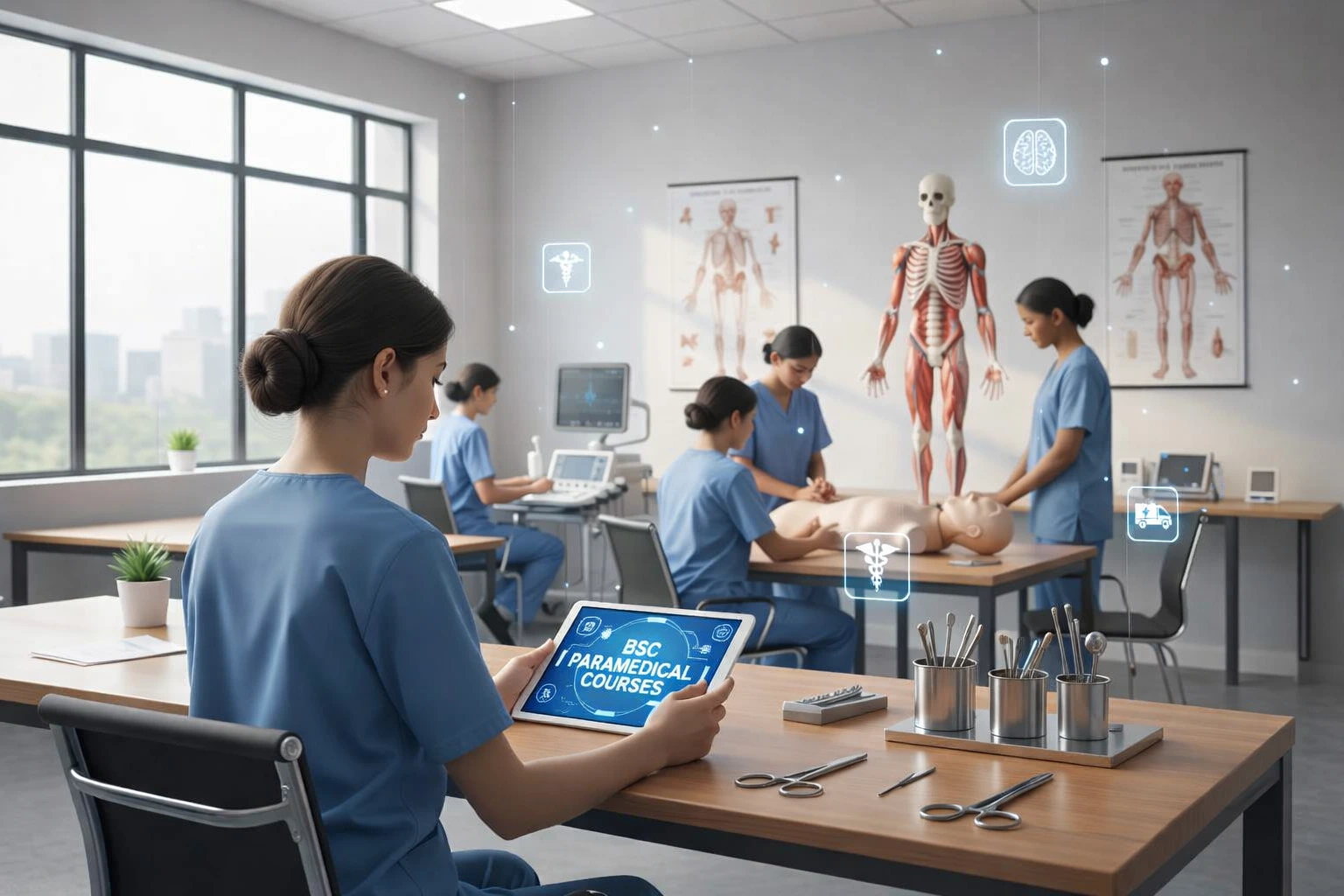
The basic paramedical eligibility requires passing Class 12 with Physics, Chemistry, and Biology with a minimum of 45-50% marks. NEET is not required for most paramedical programmes.
Admissions Open for September 2026 Intake - Limited Seats
Paramedical
Paramedical Course Details : Syllabus, Fees & Eligibility
May 12th , 2026
If you are a science student exploring healthcare careers, understanding the paramedical course details is the most important step before making a decision. From lab diagnostics, cardiac care, emergency service to cancer treatment, the paramedical courses list covers a wide range of specialisations with strong job demand and consistent salary growth.
But before you choose, you need to understand the complete paramedical course details, what each course covers, the course duration, eligibility, fees and what the paramedical syllabus looks like. This guide covers everything clearly so you can make a confident career decision.
What Are Paramedical Courses?
Paramedical courses are healthcare programmes that train students to support doctors, surgeons, and nurses in diagnosis, treatment, and patient care. These professionals work in hospitals, operation theatres, diagnostic labs, ICUs, dialysis centres, and emergency services.
Unlike MBBS, paramedical courses do not require NEET. Admission is based on Class 12 Science marks, making this one of the most accessible pathways into the healthcare sector for students who want a stable, practical career.
Without a lab technician, no diagnosis is confirmed. Without an OT technician, no surgery can begin. Without a dialysis technician, no kidney patient receives treatment. These professionals are not in the background; they are the backbone of clinical healthcare in India.
Get Admission to Top Paramedical Courses At Leading Universities Across India - 100% Placement Support - Admissions are Open for 2026 Batch


Paramedical Course Syllabus 2026
The paramedical syllabus 2026 is designed to build both theoretical knowledge and strong practical clinical skills. While the exact paramedical syllabus varies by specialisation and university, here is the general structure followed across most 4-year BSc programmes:
Year-Wise Paramedical Syllabus Overview
Year 1: Foundation Sciences
- Human Anatomy and Physiology
- Biochemistry and Microbiology
- Basic Medical Sciences and Terminology
- Hospital Orientation and Patient Safety Protocols
Year 2: Core Clinical Sciences
- Pathology and Pharmacology
- Specialisation-specific theory (cardiac anatomy for CVT, renal physiology for dialysis)
- Introduction to clinical lab procedures and equipment handling
- Medical ethics and communication
Year 3: Advanced Specialisation and Clinical Practice
- Advanced diagnostic or therapeutic techniques
- Equipment handling and operation in real hospital settings
- Patient care, case documentation, and clinical rotations
Year 4: Hospital Internship (12 Months)
- Full-time clinical internship inside a partner hospital
- Real patient exposure in relevant departments
- Case studies, assessments, and final university examinations
The paramedical syllabus 2026 across leading universities is aligned with NCAHP (National Commission for Allied and Healthcare Professions) guidelines, ensuring your qualification is accepted across hospitals and government recruitment bodies in India.
Specialisation Wise Syllabus Highlights
| Course | Key Syllabus Topics |
|---|---|
| BSc Cardiovascular Technology | ECG, Echocardiography, Cath Lab procedures, Holter monitoring, Cardiac rehabilitation |
| BSc Dialysis Therapy Technology | Renal anatomy, Haemodialysis, Peritoneal dialysis, Water treatment systems |
| BSc Emergency Medical Technology | Trauma care, BLS, ACLS, Pre-hospital emergency management, Disaster response |
| BSc Anaesthesia & OT Technology | Anaesthesia techniques, Surgical assistance, Sterilisation, Infection control, ICU care |
| BSc Medical Radiology & Imaging | X-ray, CT scan, MRI, Ultrasound, Fluoroscopy, Radiation safety |
| Bachelor in Radiotherapy Technology | Radiation physics, Treatment planning, Brachytherapy, Radiation safety protocols |
| BSc Respiratory Technology | Pulmonary function testing, Ventilator management, Oxygen therapy, Sleep studies |
| BSc Medical Laboratory Technology | Haematology, Microbiology, Biochemistry, Blood bank management, Quality control |
Eligibility for Paramedical Courses
Understanding paramedical eligibility clearly before applying saves time and avoids confusion. Here are the standard requirements, including paramedical course duration and eligibility, across most levels:
Paramedical Eligibility: Level Wise
| Course Level | Duration | Minimum Qualification | Minimum Marks | NEET Required |
|---|---|---|---|---|
| Certificate | 6 Months – 1 Year | Class 10 or 12 (Science) | 40% – 50% | No |
| Diploma | 2 Years | Class 12 with PCB | 45% – 50% | No |
| BSc Degree | 4 Years | Class 12 with PCB | 45% – 50% | No |
| MSc / PG | 2 Years | BSc in relevant paramedical field | 50% – 55% | No |
Key Points on Paramedical Eligibility
- Stream: Physics, Chemistry, and Biology (PCB) is required for most programmes. Some diploma courses also accept PCM students.
- Age: Minimum 17 years at the time of admission.
- NEET: Not required for any paramedical course listed above. Admission is based on Class 12 marks or university-level entrance tests.
- Reserved Categories: Most universities offer a 5% relaxation in minimum marks for SC, ST, and OBC candidates.
- Entrance Exams: GCET, WBJEE, JENPAS, SAAT, and AIIMS BSc Paramedical are among the most common. Many private institutions offer direct merit-based admission.
- Some state universities conduct their own entrance tests.
The eligibility for paramedical courses is straightforward and more accessible than MBBS, making it a popular choice for students who want a healthcare career without the pressure of national entrance exams.
Paramedical Course Fees in India
The paramedical course fees vary depending on the programme level, the type of institution, and the city. Paramedical course fees in government colleges are significantly lower compared to private colleges, making government institutions the preferred choice for budget-conscious students.
Fee Structure for Paramedical Courses: Level Wise
| Course Level | Government College Fees | Private College Fees |
|---|---|---|
| Certificate (6 Months – 1 Year) | ₹5,000 – ₹25,000 | ₹20,000 – ₹80,000 |
| Diploma (1 – 2 Years) | ₹10,000 – ₹60,000/year | ₹40,000 – ₹1,20,000/year |
| BSc Degree (4 Years) | ₹15,000 – ₹80,000/year | ₹1,50,000 – ₹2,50,000/year |
| MSc / PG (2 Years) | ₹20,000 – ₹1,00,000/year | ₹80,000 – ₹2,50,000/year |
Fees may vary depending on the course specialisation, hospital training, internship facilities, city, and institution type.
Get Admission to Top Paramedical Courses At Leading Universities Across India - 100% Placement Support - Admissions are Open for 2026 Batch
Final Thoughts
Paramedical courses are not a backup option; they are among the most practical, stable, and rewarding healthcare careers you can pursue in India today. The demand is real, paramedical course fees are manageable, eligibility for paramedical courses is accessible, and salary growth is consistent with experience and specialisation.
The only thing that separates a good career from a great one is where you train and how well you are prepared for the real world.
Want to know more? Read our complete guide on Paramedical Scope and Salary in India to understand exactly where this career can take you.
Ready to Choose the Right Paramedical Course?
Get free career guidance from an Emversity Counsellor and find the programme that fits your goals.
Get Free Consultation
Talk to our experts today
Related Blogs
Frequently Asked Questions (FAQs)
Get quick answers to the most common questions about paramedical course