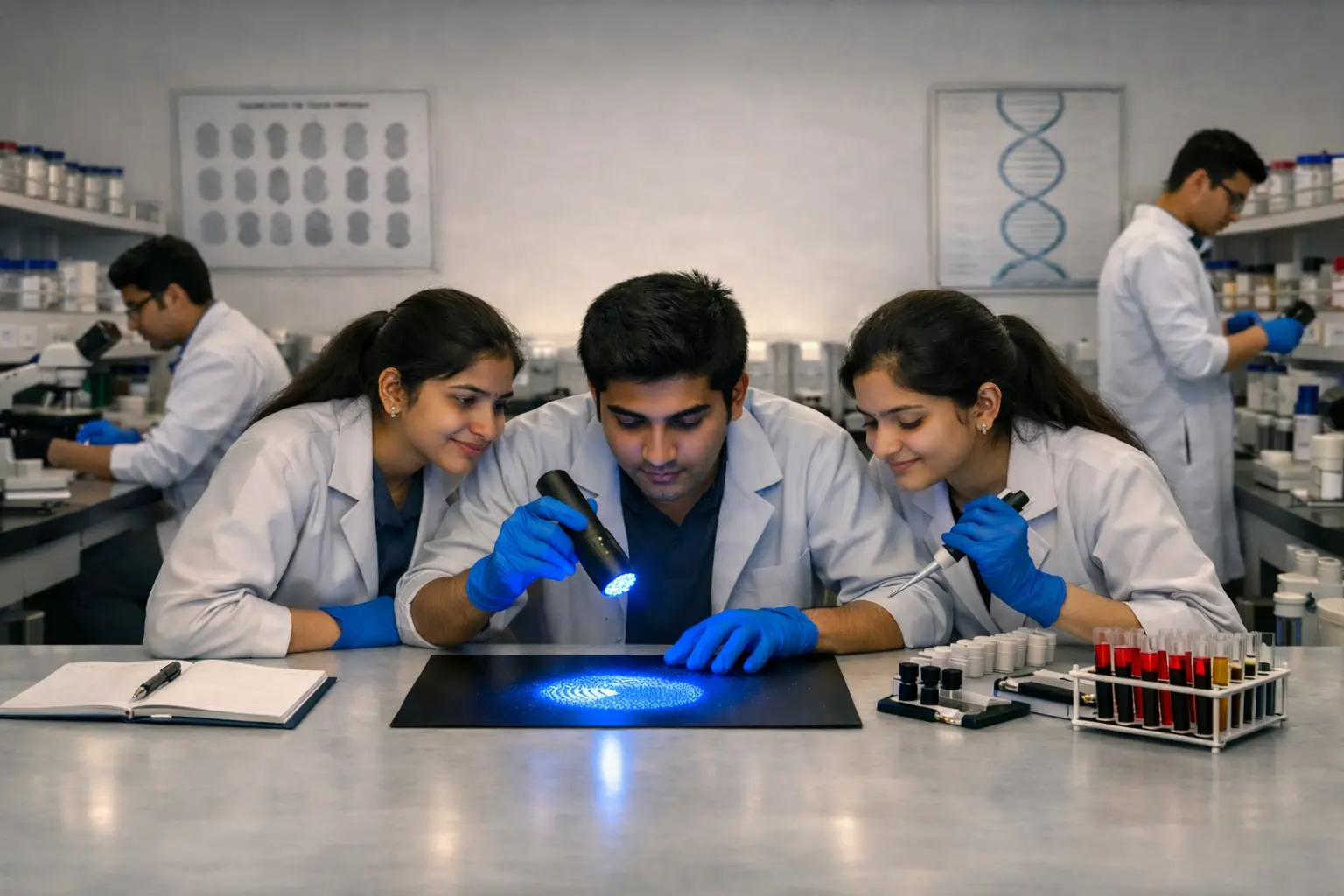

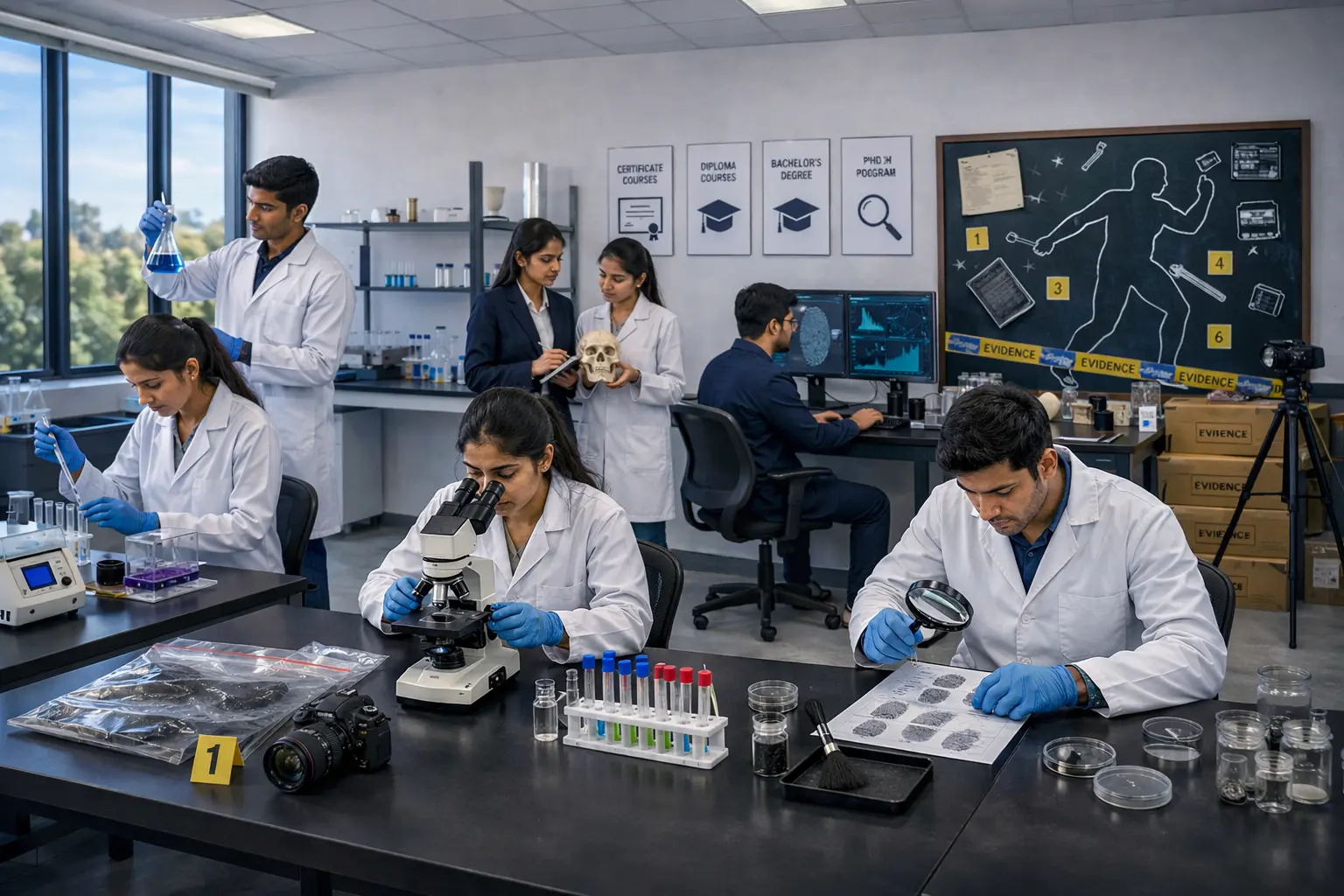

MSc Forensic Science is a two year postgraduate program that focuses on advanced scientific techniques used in crime investigation and evidence analysis. It covers subjects such as forensic biology, toxicology, DNA profiling, digital forensics, and criminal investigation methods. The course prepares students for laboratory based and investigative roles in forensic science.
Admissions Open for September 2026 Intake - Limited Seats
Allied Healthcare
MSc in Forensic Science: Course Details, Scope, Salary, Eligibility and Job Opportunities
May 28th , 2026
If you have completed your BSc and are considering MSc Forensic Science as your next step, you are already asking the right question.
Most BSc graduates reach a point where the basics are not enough. Roles that offer real growth, such as forensic scientist, DNA analyst, toxicologist, digital forensics expert, and scientific officer, usually require candidates to have an MSc in Forensic Science and advanced practical knowledge.
India’s forensic infrastructure is expanding rapidly. New forensic laboratories are being established, cybercrime units are growing, and the demand for skilled forensic professionals is increasing across both government and private sectors.
An MSc in Forensic Science helps you build deeper technical expertise, gain hands-on laboratory exposure, and improve your career opportunities in specialised forensic fields. It also opens doors to higher paying roles, research opportunities, and government forensic jobs.
This guide covers everything, including eligibility, entrance exams, syllabus, fees, colleges, salary, and career scope in India, so you can take your next step with complete confidence.
What is MSc Forensic Science?
MSc Forensic Science is a two year postgraduate program that trains students in the scientific methods and laboratory techniques used to investigate crimes, analyse physical evidence, and support the criminal justice system.
The program builds on the foundational knowledge gained during undergraduate studies and introduces advanced subjects, including forensic biology, forensic chemistry, toxicology, digital forensics, ballistics, questioned document examination, and criminal profiling.
The course combines theoretical learning with practical laboratory training, case studies, and research projects to prepare students for technical and investigative roles in government agencies, forensic laboratories, hospitals, and private organisations.
Students who complete this degree develop analytical skills, scientific expertise, and professional competence required for advanced forensic careers in India and abroad.
Start Your Medical Career with Forensic Science from Top Universities - 100% Placement Support - Admissions are Open for 2026 Batch


MSc Forensic Science Course Details
Here is a quick overview of the key course details before exploring each section in depth.
| Course Detail | Information |
|---|---|
| Course Name | MSc in Forensic Science |
| Course Level | Postgraduate |
| Course Duration | 2 Years (4 Semesters) |
| Eligibility | BSc in Forensic Science or related field with minimum 50% marks |
| Admission Mode | Entrance exam based or merit based |
| Training Pattern | Classroom learning, laboratory sessions, and research project |
| Course Focus | Forensic biology, toxicology, digital forensics, DNA profiling, and criminal investigation |
| Career Area | Forensic laboratories, government agencies, cybercrime units, hospitals, and private investigation firms |
| Higher Study Options | PhD in Forensic Science, specialised certifications, and research programs |
MSc Forensic Science Duration
The MSc Forensic Science course lasts 2 years and is structured into 4 semesters. During the program, students receive advanced theoretical knowledge, practical laboratory exposure, forensic case analysis training, and research experience. Most universities also include a dissertation, internship, or research project in the final semester to help students gain hands-on experience in specialised forensic domains.
| Duration | Semester Structure | Training Included | Final Year Component |
|---|---|---|---|
| 2 Years | 4 Semesters | Laboratory Training, Practical Sessions, Case Analysis | Dissertation / Research Project / Internship |
For working professionals, some universities may also offer part time or distance learning options, which can extend the duration up to three years.
MSc Forensic Science Scope in India
The MSc forensic science scope in India is growing because modern crime investigations depend on scientific evidence such as DNA, fingerprints, and digital records to solve cases.
-
Expansion of Cybercrime Investigation
The scope of MSc Forensic Science is strongly influenced by the rapid rise in cybercrime cases such as online fraud, hacking, identity theft, and digital financial crimes. As these cases become more complex, the need for experts who can scientifically analyse digital evidence and reconstruct cyber activities is increasing. -
Modernisation of Forensic Infrastructure
The MSc forensic science scope is also improving due to the expansion of forensic laboratories and upgraded investigation facilities across India. Better technology, improved laboratory systems, and government support are making forensic investigations more accurate and widely used in criminal cases. -
Higher Studies and Research Opportunities
The career after MSc in Forensic Science also extends into higher education and research. Students can pursue PhD programs and specialised research in forensic disciplines, thereby developing deeper expertise and contributing to advancements in forensic science. -
Increasing Role in the Criminal Justice System
Forensic science is now playing a more important role in courts and investigations, where scientific evidence is used to support accurate and fair decision making. This has strengthened the long term relevance and importance of forensic science in India.
Start Your Medical Career with Forensic Science from Top Universities - 100% Placement Support - Admissions are Open for 2026 Batch
Jobs After MSc Forensic Science
Jobs after MSc Forensic Science are available in both government and private sectors. These roles involve forensic investigation, laboratory analysis, support for cybercrime investigations, and scientific reporting.
MSc forensic science jobs are available in government forensic laboratories, investigation agencies, cybercrime units, hospitals, and private forensic companies across India.
Government Organisations Recruiting MSc Forensic Science Graduates
- Directorate of Forensic Science Services (DFSS)
- Central Forensic Science Laboratories (CFSL)
- State Forensic Science Laboratories (FSLs)
- Central Bureau of Investigation (CBI)
- National Investigation Agency (NIA)
- Intelligence Bureau (IB)
- Narcotics Control Bureau (NCB)
- State Police Departments and Cyber Crime Cells
- National Crime Records Bureau (NCRB)
- Government Hospitals (Medico-Legal Departments)
- National Forensic Sciences University (NFSU)
Government Jobs After MSc Forensic Science
| Job Role | Key Responsibility |
|---|---|
| Forensic Scientist | Analysis of physical, biological, and trace evidence in criminal cases |
| Scientific Officer | Laboratory-based forensic examination and report preparation |
| Fingerprint Expert | Fingerprint collection, comparison, and identification |
| Toxicologist | Detection and analysis of poisons, drugs, and chemicals |
| Document Examiner | Handwriting, signature, and forged document verification |
| DNA Analyst | DNA profiling and biological evidence analysis |
| Cyber Forensic Analyst | Digital evidence recovery and cybercrime investigation |
| Forensic Psychologist (limited roles) | Criminal behaviour analysis and profiling support |
Students can explore MSc forensic science jobs in areas such as DNA analysis, cyber forensics, toxicology, fraud investigation, digital security, and forensic research.
Private Sector Recruiters for MSc Forensic Science
- Cybersecurity Companies
- Banks and Financial Institutions
- Insurance Companies
- Pharmaceutical Companies
- Legal Consulting Firms
- Corporate Risk and Compliance Firms
- Private Investigation Agencies
- IT and Data Security Companies
Private Sector Job Roles After MSc Forensic Science
| Job Role | Sector |
|---|---|
| Digital Forensics Analyst | Cybersecurity and IT industry |
| Fraud Investigation Specialist | Banking and Insurance sector |
| Forensic Consultant | Legal and corporate sectors |
| Cybercrime Analyst | Technology and digital security firms |
| Research Scientist | Pharma, biotech, and forensic research labs |
| Compliance and Risk Analyst | Corporate governance and financial sector |
Job availability after MSc Forensic Science depends on:
- Competitive examinations (for government jobs)
- Technical skills and certifications (for private jobs)
- Specialisation chosen during postgraduate studies
MSc Forensic Science Salary in India
The salary after MSc in Forensic Science depends on job role, sector, experience level, and area of specialisation. Government positions offer stable income and additional benefits, while private-sector roles, especially in digital forensics and cybersecurity, offer faster salary growth with experience and skill development.
Average Salary After MSc in Forensic Science
| Job Role | Starting Salary | Experienced Salary |
|---|---|---|
| Forensic Scientist | ₹3.5 - ₹5.5 LPA | ₹7 - ₹12 LPA |
| Scientific Officer Government | ₹4 - ₹6.5 LPA | ₹8 - ₹13 LPA |
| DNA Analyst | ₹3.5 - ₹5.5 LPA | ₹7 - ₹12 LPA |
| Toxicologist | ₹3 - ₹5 LPA | ₹6.5 - ₹11 LPA |
| Digital Forensics Analyst | ₹4 - ₹7 LPA | ₹10 - ₹18 LPA |
| Cybercrime Investigator | ₹3.5 - ₹6 LPA | ₹8 - ₹14 LPA |
| Forensic Consultant | ₹4 - ₹7 LPA | ₹9 - ₹18 LPA |
| Research Scientist | ₹3 - ₹5 LPA | ₹6.5 - ₹11 LPA |
The salary after MSc Forensic Science in India increases with experience, specialisation, and skill development. Freshers usually start with moderate packages, while professionals in advanced forensic fields such as digital forensics and cybercrime investigation can achieve significantly higher earnings over time.
MSc Forensic Science Eligibility
Understanding the MSc Forensic Science eligibility criteria is important before applying to any university. The requirements may vary slightly by institution, but the general guidelines are as follows.
General Eligibility Criteria
- Candidates must hold a Bachelor’s degree in Forensic Science or related science disciplines such as Life Sciences, Chemistry, Biochemistry, Microbiology, Biotechnology, Botany, Zoology, or Physics.
- A minimum of 50% aggregate marks at the undergraduate level is generally required (45% for reserved categories in some universities).
- Students with a BSc in Forensic Science are directly eligible and often preferred during admissions.
- Some universities may also accept graduates from Computer Science, Psychology, or related fields for specialised forensic programs.
Eligibility for Specific Specialisations
| Specialisation | Preferred Background |
|---|---|
| Forensic Biology / DNA Analysis | Life Sciences, Biotechnology, Biochemistry, Forensic Science |
| Forensic Chemistry / Toxicology | Chemistry, Pharmaceutical Sciences, Forensic Science |
| Digital Forensics / Cyber Investigation | Computer Science, IT, Forensic Science |
| Forensic Psychology | Psychology, Forensic Science |
Students planning to pursue an MSc in Forensic Science should always check the specific eligibility criteria of the university, as requirements may vary by specialisation and institutional policies.
MSc Forensic Science Fees
The MSc Forensic Science fees in India vary depending on the type of institution, infrastructure, laboratory facilities, and university reputation. Government universities generally offer affordable education, while private and deemed universities charge higher fees due to advanced laboratory setups and additional academic facilities.
MSc Forensic Science Fees Structure in India
| Institute Type | Total Course Fees (2 Years) |
|---|---|
| Government and Central Universities | ₹20,000 - ₹80,000 |
| State Government Universities | ₹25,000 - ₹1.2 Lakhs |
| Private Universities and Institutes | ₹1 Lakh - ₹3 Lakhs |
| Deemed Universities | ₹2 Lakhs - ₹4 Lakhs |
Additional Cost Factors
- Examination fees
- Laboratory charges
- Library and academic resource fees
- Hostel and accommodation fees (if applicable)
- Fieldwork or training related expenses (in some universities)
The MSc Forensic Science fees in India may vary from one university to another, depending on the course structure, facilities, and specialisation. Students are advised to check the official university website for the most up-to-date fee details before applying.
MSc Forensic Science Entrance Exam
Most reputed universities in India require candidates to clear an MSc Forensic Science entrance exam as part of the admission process. These exams generally assess candidates on general science knowledge, forensic fundamentals, reasoning ability, and subject based understanding.
Common Entrance Exams for MSc Forensic Science
| Entrance Exam | Conducting Body | Level |
|---|---|---|
| CUET PG | National Testing Agency (NTA) | Central University Entrance Exam |
| LPUNEST | Lovely Professional University | University Level |
| State University Entrance Tests | Respective State Universities | State Level |
| University Specific Exams (if applicable) | Individual Private Universities | University Level |
MSc Forensic Science Entrance Exam Syllabus Overview
- General Forensic Science concepts and terminology
- Forensic Biology, Serology, and DNA Profiling Basics
- Forensic Chemistry and Toxicology Fundamentals
- Fingerprint science and questioned document examination
- Criminology and the criminal justice system
- General aptitude and logical reasoning
- Basic computer science (especially for digital forensics programs)
Candidates should always refer to the official website of the respective university for the latest MSc Forensic Science entrance exam syllabus and pattern, as these may vary by institution.
MSc Forensic Science Syllabus
The MSc Forensic Science syllabus is designed to provide advanced theoretical knowledge, along with practical laboratory training, across the major areas of forensic investigation. The exact subjects may vary slightly from university to university, but the overall structure remains similar across most institutions in India.
Semester-wise Syllabus Overview
| Semester | Core Subjects |
|---|---|
| Semester 1 | Criminalistics, Forensic Biology, Forensic Chemistry, Criminal Law and Evidence Act, Laboratory Techniques |
| Semester 2 | Forensic Toxicology, Fingerprint Science, Questioned Document Examination, Forensic Photography, Ballistics |
| Semester 3 | DNA Profiling, Digital Forensics and Cybercrime, Forensic Psychology, Basics of Forensic Medicine, Criminal Profiling |
| Semester 4 | Research Methodology, Advanced Instrumentation, Environmental Forensics (in some universities), Dissertation / Project Work |
Practical and Laboratory Training
- Crime scene simulation and evidence collection
- Forensic serology and blood analysis
- Toxicology testing and drug examination
- Fingerprint development and comparison
- Digital evidence recovery and cyber analysis
- Forensic photography and documentation
- Medico-legal examination techniques
These practical sessions help students gain hands-on experience in forensic techniques and apply theoretical knowledge to real investigative situations.
MSc Forensic Science Admission Process
The MSc Forensic Science admission process in India follows a structured pathway that may vary slightly by university. Understanding the process in advance helps students plan their applications more effectively.
Step-by-Step Admission Process
- Research and shortlist universities offering MSc Forensic Science based on specialisation, fees, and location.
- Check the specific MSc Forensic Science eligibility criteria for each selected university.
- Register and appear for the relevant MSc Forensic Science entrance exam, such as CUET PG or university level tests.
- Fill out the application form on the official university portal and upload the required documents.
- Attend counselling sessions or personal interviews, if required by the institution.
- Receive the admission offer letter and complete the fee payment to confirm enrollment.
Documents Generally Required
- Undergraduate degree certificate and marksheets
- Class 10 and Class 12 certificates
- Entrance exam scorecard
- Identity proof and passport-size photographs
- Category certificate (if applicable)
- Migration certificate (for students from other universities)
The MSc Forensic Science admission process in India usually takes place between March and June for many universities, with the academic session starting around July or August. However, admission timelines may vary depending on the university, entrance exam schedule, and intake system.
Start Your Medical Career with Forensic Science from Top Universities - 100% Placement Support - Admissions are Open for 2026 Batch
Final Thoughts
Behind every solved crime is a forensic professional whose name is rarely seen, yet their work plays a crucial role in reaching the truth and supporting justice.
This is the kind of career an MSc in Forensic Science prepares you for. It is not just a routine job but a profession that connects science, law, and real human impact in a meaningful way.
In India, the forensic science sector is steadily growing. New laboratories are being established, existing facilities are expanding, and the demand for skilled forensic professionals is increasing across government and private institutions.
The professionals trusted with these responsibilities are those who have developed deeper scientific knowledge and practical expertise through advanced study and training.
If you already have a foundation in science at the undergraduate level, you are already on the right path. A career after MSc in Forensic Science is not only achievable but a natural next step for those who want to build a meaningful and evidence based profession.
Get Free Consultation
Talk to our experts today
Related Blogs
Frequently Asked Questions (FAQs)
Everything You Need to Know About MSc Forensic Science